Monday, November 17, 2014

Procreation

It sure is funny how your mind wanders when you are in bed, recovering from an illness, half-way between sleep and alertness...

It was two weekends ago when the flu hit me - hard. I had all the typical symptoms and I spent a lot of time in bed, trying to rest and help my body fight-off the infection. It was during this time, that my mind wandered to thoughts of procreation and I marveled at the complex series of biochemical reactions which keep us all alive.

A few decades ago I remember learning that hard-wired in all living organisms is the fervent desire to ensure that they create offspring, so that their genetic material (DNA for humans) survives once they are no longer on this Earth. A definition of procreation could be the desire to create offspring, which will create more offspring, etc. Each species, in other words, wants to make sure that others like them will be around in the future.

If you are an animal, you need to worry about whatever predator(s) plans on having you for dinner. If you are a plant, you need to worry about the climate wherever you happen to have sprouted, as well as those animals which might come around and gobble you up. Regardless of what type of living organism you might happen to be, you also need to compete with other organisms for a limited amount of resources which are needed to sustain you. This is what scientists term the "Carrying Capacity" of an ecosystem, which I touched-upon in a previous post.

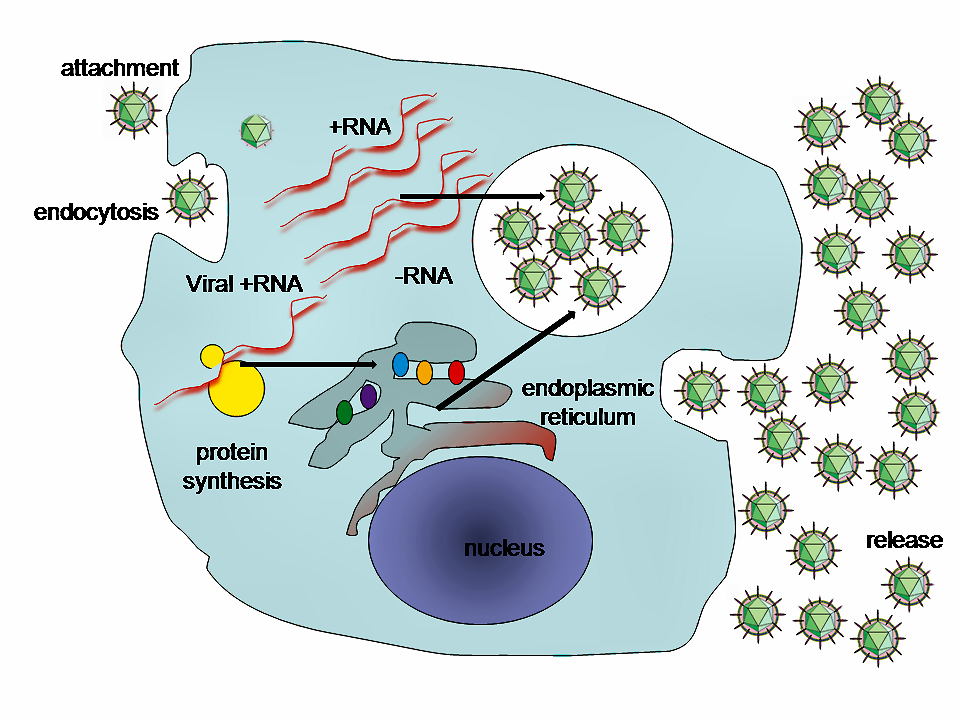
Thinking back to living things and the desire for procreation, I got to thinking about whatever virus was wreaking havoc on my body. While viruses are not technically living things, they are remarkably efficient at procreation. By hijacking other living cells, they force them to churn out many new copies of themselves, depleting the resources available to the infected cells and many times killing those host cells in the process. [Merriam-Webster definition of Virus]
Those new copies of the virus are then available to infect new cells, creating even more copies of themselves and starting the cycle anew.


Of course organisms have developed defensive mechanisms, which fight to eliminate the viruses infecting the organism's cells (in the process of fighting the infecting viruses, they can trigger symptoms such as those that were making me miserable). If however a virus has no way of leaving the body of the infected organism, its efforts at procreation will end when it exceeds the organism's carrying capacity (and the organism dies), or when the organism's defensive systems wipe-out all copies of the virus. Therein lies the sneaky genius of viruses: those that are effective at procreation have developed various means of jumping from one organism to another.

Two news stories about viruses caught my attention right around the time I was coming down with the flu.
The first dealt with Ebola, that modern day scourge which seems to suddenly show a resurgence in Western Africa, and what scientists are discovering about it's lethality related to an infected person's age (bad news for people my age).
The second dealt with something a bit stranger ... and scarier. Scientists examining ice cores from Northern Canada discovered two new types of viruses in frozen Caribou droppings that were 700 years old -- viruses are able to survive for centuries in ice.

Viruses are by far the most abundant biological entities on Earth and they outnumber all the others put together. They infect all types of cellular life including animals, plants, bacteria and fungi.
New versions/types of viruses keep getting created through genetic mutations.
Thankfully, genetic mutations also allow the various organisms at risk from viruses to evolve and cope with the viral onslaught.

It staggers my mind to think of the glorious system of checks and balances present in the environment we live in and causes me to pause in awe at the way life has evolved on this planet we call Earth.

Thursday, October 30, 2014

Lost and Found

Trade shows are hard on the feet - you are on your feet all day, walking around from booth to booth. It gets worse if you are a staff member in a booth, since you spend most of your time standing.
It feels great to have the opportunity to sit down every once in a while and take a load off your feet.
A hard chair feels blissful, while a comfortable couch feels downright heavenly.

There are hidden dangers associated with couches however, which trade show attendees and exhibitors need to keep in mind.

My friend Bob Walker had found a coveted spot on a couch while attending the Greenbuild trade show on Oct. 22. He enjoyed a few minutes of rest while he made a phone call. As he got up to leave, he spotted some folded bills on the couch next to him.
They were not his, so he figured they must have slipped out of the pocket of another attendee who was sitting next to him.
When he examined them closer, Bob discovered there was a fair amount of cash there, as well as a driver's license ... he also found a credit card and a hotel room key card!

When Bob returned to our booth, he showed me what he had found. We quickly came to the conclusion the owner would be frantic. Not only would he be unable to get into his hotel room, he would not be able to travel either (a driver's license is required before someone is allowed to board a plane).

Bob went to the trade show registration desk, explained what had happened and asked for a phone number associated with the name on the driver's license. It was a work number, however the person who answered the phone there stated that no one by the name on the driver's license worked there... The registration desk then called the hotel and left a message for the guest.

Fast forward to Oct. 23. I was in the booth when the show opened in the morning. A gentleman arrived, looking for Robert Walker. I explained Bob had left and asked if there was something I could help him with. He explained he was the owner of the cash and cards Bob had found and wanted to thank him personally for turning them in.

I accepted his gratitude on Bob's behalf - well played Mr. Walker!

Monday, October 20, 2014

Robots

Wow, it has been a LONG time since I posted here ... please accept my profuse apologies

It started with the Jetsons, I think.
I remember the robot maid and other time- & labor-saving appliances used in the cartoons I watched as a child.


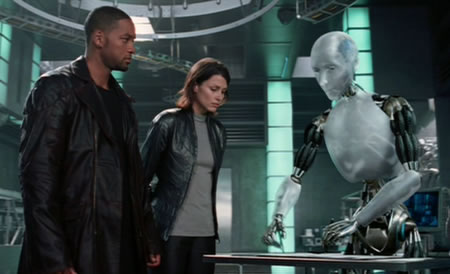
Then came Asimov -- he had me hooked as I voraciously consumed his stories about the future and all things robotic during my teen years: I, Robot

In college, I remember Hajime Sorayama's robot creations adorning the walls to my room:


Shortly after the turn of the century, I remember a friend telling me about this uber-cool robotic vacuum cleaner he had bought called a Roomba and how it was the shape of things to come:


In 2004 came the (loose) movie adaptation of Asimov's vision: I, Robot


Fast-forward to 2014. Where are the robots today?

I feel a bit let-down, even though I hear of advances such as medical assistant robots and future robotic assistants, such as Jibo, which are slowly advancing towards a robotic future.

I found the following article illuminating, especially since the title agrees with my question above: iRobot CEO decries the slow advance of robotics.

Here's an interesting insight from the article:
Pam Henderson, a former assistant professor at Carnegie Mellon University and co-founder and CEO of consulting firm NewEdge, Inc., agreed, adding that too many roboticists are in love with their own ideas.
"Some of you have one idea you are in love with and you are going to ride that thing until it goes to market or it kills you," Henderson said during a keynote talk at RoboBusiness. "Robotics is not the industry. Appliances are the industry. Home health care is the industry. The need isn't for a robot.... What's the opportunity? No opportunity? Don't build. Be pretty crisp on the applications before you do the development."

In the end, it comes down to money:
"It takes $20 million or more to build a legitimate robot. It's a much bigger check to write to get to play," said Colin Angle, CEO and co-founder of iRobot (the maker of the Roomba vacuum cleaners).

Allow me to add my personal appeal to all the Angel Investors out there:
Please don't overlook the robots!

Sunday, December 4, 2011

The Blame Game

I read an article in the Nov. 26 issue of The Economist, titled "A downgrade for Congress". 
It begins: "It was not a very ambitious target.  All that the congressional "supercommittee" was required to do was to figure out a list of measures that would reduce America's budget deficits by $1.2 trillion over the next ten years.  That sounds like a lot, until you realise it is only 0.6% of GDP, not even a quarter of the $5 trillion or so that is really needed to right the books in Washington, and less than 3% of the $44 trillion that the federal goverment is expected to spend over that period.  To reach a goal that a business cost-cutter would regard as desultory, the bipartisan committee of 12 senators and congressmen was accorded exceptional powers.  Its work was to be subject to a simple up-or-down vote, with no possibility of amendment; and the Senate would not be able to use its power to filibuster.  Yet on November 21st, after three months of deliberation, the team was forced to admit that it had failed."

And the Blame Game kicked into high gear, the Democrats blamed the Republicans, the Republicans blamed the Democrats and the public was left shaking our collective heads at the degree of dysfunction we witness daily amongst our elected officials and the partisanship which has been elevated to a new level.

The article concludes with one suggestion why the supercommittee might have failed to meet its goal = no real sense of urgency.  "America is not Italy: this week, its ten-year government bonds were trading at well below 2%, the lowest levels for over half a century ..."

Which brings me to the last point I wanted to make regarding the "Blame Game."
I was thoroughly disgusted with all the blame being heaped upon little ole Greece during the summer and early Autumn.  Yes, the Greek politicians had managed (mismanaged sounds better) to completely over-leverage their country and had dug a massive hole for themselves -- and the various bankers were all-too-happy to saddle them with bailouts, which, it should be pointed-out, are not "gifts", but rather additional loans with crushing terms.  Massive austerity measures were depressing everything and everybody in Greece and the rest of the world was using it as a scapegoat for the mess the Europeans were finding themselves in ... blame it all on the Greeks!

That's where the other shoe dropped.  Wait a minute ... perhaps Italy has an economic problem, oh and Spain too.  Italy isn't a small economy, like Greece, they are the #3 economy in the Euro zone.
Now all of a sudden the European economic powerhouses are calling an emergency meeting early next week to figure a way out of the looming economic meltdown ...

I wonder who will be blamed next.
More importantly, I hope the Blame Game stops and we start seeing the politicians and the bankers working cooperatively to bring the world economy back to health.

Tuesday, November 1, 2011

Food, Water, Energy and Population Growth

I had the opportunity to eat a Primanti"s sandwich last week, which got me thinking ... more on this in a moment.

For those of you who may have not heard of this before, Primanti Brothers is a chain of restaurants in Pittsburgh, who serve a rather unique sandwich that has attained iconic status in this city.
The history behind this sandwich is fun to read, though I have a hard envisioning somebody eating this sandwich with one hand, while driving a truck with the other ... it is simply (huge http://en.wikipedia.org/wiki/Primanti_Brothers).

We heard on the news a month ago, that Primanti's has been named one of the "manliest" sandwich restaurants in the nation - a rather dubious honor, but one which caused more than a few smiles. 
In case you want proof, here is a link to a picture of me eating my Primanti's sandwich - snapped by my sister (https://www.facebook.com/#!/photo.php?fbid=10150373631472512&set=at.66614997511.70714.820847511.820847511&type=1&theater).

Enough with the frivolity however.  What triggered this blog post was a story I heard over the weekend, that global population would reach an estimated 7 billion people on Monday, Oct. 31, 2011 and related news stories yesterday and this morning.
You may enjoy watching the video at the top of this story, which helps visualize the growth of the Earth's population over the last few thousand years (http://www.npr.org/2011/10/31/141816460/visualizing-how-a-population-grows-to-7-billion).

The question of how many more people can live on Earth, what some scientists call Earth's carrying capacity, is a very complex one, with many variables potentially coming into play (http://en.wikipedia.org/wiki/Carrying_capacity). One way to simplify the equation, is to talk about food, water and energy.

The food part of the equation is how I started this blog post -- meat and animal-derived products require more land and resources than grain-based foods -- the thinking is that as more people around the world enter the middle class, they will want more meat and animal-derived products, which will strain global food production.  Improvements in agriculture may be able to offset this increased demand (to a point).

The water part of the equation is one which seems to be more dramatic in some parts of the world than in others.  It is fair to say however, that access to clean water for an increasing global population will be a huge problem to overcome in the years to come.  Water supply and purification mechanisms, as well as improvements in infrastructure to deliver the clean water to the population with minimal losses (and to remove the dirty water), will be definite areas of attention.

Then there is energy.  One news story mentioned that parts of the world which are more developed are currently enjoying "cheap energy" and that the developing world will also want access to the same amount of energy being consumed in the more developed countries. A finite oil and fossil fuel supply is only part of the problem here -- it is also worth considering the energy efficiency of whatever we use which consumes energy and also energy wasted due to carelessness.

One of the areas of my job I truly enjoy, is related to AEVs (Alternative Energy Vehicles) and all the lightweight and energy-efficient materials my company supplies which can decrease the weight of any vehicle while simultaneously increasing their energy-efficiency.  If you are interested in finding out more about this, feel free to check-out our Facebook page -- and if you like what you see, kindly click on the "Like" button too (https://www.facebook.com/BayerMaterialScienceAEV).  Thanks!

Tuesday, September 6, 2011

The 118

I was reminded today of a phrase I heard from Jeffrey Hayzlett (ex-CMO at Kodak).   
He was talking about "The Elevator Pitch" - 2.0 
He calls it "The 118" -- as in: "you have 118 seconds to get your point across". 

His position is that the average adult's attention span is 8 seconds -- that's all the time someone has to make an initial impact.  The other 110 seconds, what Jeffrey claims is the average time an elevator ride lasts in NYC, is how long you have to "sell" him/her. 

Phrased differently, if you are preparing a long-winded presentation, hoping to impress me, you are approaching this the wrong way.
Obviously, you will not be able to come up with the correct words and to structure your position/proposition in that short a time period without some serious preparation and practice. 
... so heads-up, make sure you practice!

I got a cold call today, from someone talking 100-miles-an-hour, hoping to impress me by throwing out names of well known, major companies, who he claimed were clients -- *yawn*!
After 30 seconds he had not even begun to get close to his point, after 120 seconds I still had not heard his value proposition ... so I cut him off. 
I explained he had failed to "hook" me, that I was not trying to be rude, however I was very busy and I just did not have the time to sit and listen to the stuff he was rattling off. 
It became apparent he was annoying me. 

My parting words were that he needed to practice his 118 and I gave Mr. Hayzlett and his book "The Mirror Test" a "plug". 
You are welcome Jeffrey.
Now I need to go practice my own 118 ... 
Summer vacation is over people, let's get with the program! 

Monday, August 8, 2011

The Brink

A divided government that seems stuck in perpetual gridlock, took the US economy to the brink of default, only to be saved by a last-minute agreement last week. 
Apparently this was not enough for Standard & Poors (S&P), the debt rating agency which was not capable of warning about impending problems with Lehman Brothers, or with the mortgage debt crisis a couple of years ago.  
S&P downgraded US debt from AAA to AA+ and the stock market which had been having one bad day after another for the past two weeks, had an absolutely horrendous day today.  Over the last couple of weeks, the stock market has declined by a figure that is closing-in on 20%. 

Meanwhile, the President has a mere 42% approval rating and Congress has a dismal 14% approval rating! 
The polls notwithstanding, it should be immediately obvious to even the most casual observer that the citizens of the US do not think any of the politicians are doing anywhere near an acceptable job.

I think it is clear we are not simply approaching the brink of disaster; we are teetering on the very edge.  The question before us now is: can any one of the political geniuses figure-out how to keep us from tumbling over that edge? 

Friday, July 8, 2011

Adventures in Space

I experienced a bittersweet moment today, as news arrived that the shuttle Atlantis did manage to lift off from Cape Canaveral for the last time a few hours ago, despite the inclement weather in Florida -- here in Pittsburgh as well, it is overcast and rainy.
I liked this coverage in the Washington Post (http://www.washingtonpost.com/national/atlantis-astronauts-ready-for-final-launch-as-nasa-keeps-watchful-eye-on-cloudy-weather/2011/07/08/gIQA8FcR3H_story.html?wpisrc=al_national).
I also recommend clicking on the second video link for a brief (less than 6 min) history of the Space Shuttle program from the 1st to this the 135th and final flight (http://www.washingtonpost.com/national/health-science/remembering-the-shuttle-era/2011/07/01/AG35yStH_video.html).

I have previously blogged about the "Coolest Job Ever", so my personal angle/excitement about the subject should be obvious. 
The truth of the matter however, is that the International Space Station is now manned and operational and the only existing means of moving people to/from it are the Russian Soyuz spacecraft.  Unfortunately, the Soyuz spacecraft can carry far less in both personnel and payloads/cargo than the Space Shuttles.
Since it will be years before NASA's successor to the Space Shuttle will be operational, I believe the adventures in space (OK, near-Earth orbit if you want to be nit-picky) are just beginning. 

From an economic/financial standpoint meanwhile, there will be thousands, if not tens of thousands of people currently employed by NASA, who will be added to the ranks of those seeking employment during these tough economic times.  I would like to wish each of them a speedy resolution to their personal adventure as well.

Saturday, July 2, 2011

Blurring the Line Between Games and Reality

Running errands this afternoon, I was driving and listening to the radio.
There was an extremely interesting discussion regarding how games affect us and about the future direction games may be headed in (http://www.onthemedia.org/2011/jul/01/future-gaming/). 

Why would this interest me so much you ask?
Because I really enjoy playing games! 
One of the lines uttered during the interview by the way, was that while people often play games to escape reality, more and more games are making connections to the real world (that is pretty profound).

One of the people interviewed was Jesse Schell, a professor at the CMU (Carnegie Mellon University - right here in Pittsburgh) Entertainment Technology Center and the CEO of Schell Games.  In Prof. Schell's vision of the (near?) future, he sees a time when sensors will become so ubiquitous, that all our actions every day will be recorded, tabulated and assessed.  Therefore our everyday actions in the real world, such as brushing our teeth, taking the bus instead of driving our cars, walking instead of driving, or watching certain commercials on TV, will all result in us getting awarded bonus points.  In other words our daily actions and habits will be turned into a "game" and the points we earn in the "game" will have real-world implications (such as coupons for things we buy, lower health insurance premiums, or tax credits for the examples listed above).

I know this is a foreboding look at the future and one which does not sound like much fun to some, however Prof. Schell's thesis completely blew my mind.  He stated that since all our actions will be recorded and will be available for our children and for future generations to inspect, if the "game" is designed correctly, it may be possible to modify our behaviors and inspire us to become better people than we might have otherwise turned out.

That puts a different spin on the game of Life ... or maybe it does not.

If you want to listen to Prof. Schell's talk entitled "When Games Invade Real Life", just click on the link (http://www.ted.com/talks/jesse_schell_when_games_invade_real_life.html)
** warning it lasts 28 minutes ** 

Friday, July 1, 2011

Independence

The long 4th of July weekend is upon us and thoughts naturally turn to the reason behind the holiday.
This holiday commemorates the United States' declaration of independence from Great Britain in 1776, an act considered brazen by many at the time, given Britain's overwhelming military superiority.  It also brings to mind other similar acts.

The Greek War of Independence from the Ottoman Empire in 1821 is celebrated on March 25.  This began only a few decades after the Americans and perhaps the planners of that war had been heartened and influenced to some extent by the success the Americans ultimately enjoyed in their bid for independence.  What I found interesting was the utilization of the media of the day to generate support for the Greeks among the European nations, a fact which ultimately helped lead to the intervention of Russia, France and the United Kingdom on the side of the Greeks against the Ottomans.

In the last few months we have witnessed what has been termed by some the Arab Spring with demonstrations and rebellions taking place in various Arab world nations.  What has been interesting has been the utilization of social media by the protesters, to coordinate their activities, generate global support for their causes and provide transparency into the responses employed by the various governments, even when news reporters have not been present.

Ultimately the lesson we can glean is that people don't like to be constrained and they will seek ways to become independent from whatever constrains them.  The tools they choose to use are what they have on hand and what they find to be most effective.
In today's world, social media are powerful indeed and they need to be employed by those seeking maximum effectiveness in their quest for independence from whatever is boxing them in.
I wish all my friends a happy Independence Day, however I also want to remind them to "think before you tweet".

Thursday, June 16, 2011

Think Before you Click

A blog entry by Jeff Cole, PR 101 Lesson #106 It Doesn’t Matter What You Were Told In Kindergarten – Sharing Is Not Always A Good Thing ( http://www.pr101.biz/pr-101-lesson-106-it-doesn%e2%80%99t-matter-what-you-were-told-in-kindergarten-sharing-is-not-always-a-good-thing/ ) made me think about the advice I was given some time back when I started my foray into the world of Social Media: "don't drink and tweet."  

It sounds deceptively simple and yet it is rather profound.  When you create content on the social web, or on the web in general, people will find it/see it, regardless of whether you think it is shielded or not.  The word "content" by the way, describes everything from a 140-character tweet, or a comment on a website, to a blog entry, to a picture or video you post.

In light of the above therefore, it only makes sense to employ common sense rules. 
The way I usually describe the decision point when I am sharing my experiences goes something like this -- if you could stomach seeing your content on the front page of the newspaper or on the 6 o'clock newscast, if you wouldn't mind your content discovered by your mother/spouse/friends/boss, then go ahead and click 'OK', or hit 'Enter'.  If you feel you can defend it, you are in the clear. 
If you find yourself hesitating however, then you ought to rethink the wisdom of creating this content. 

As Jeff points out, "Here’s the first thing that we all should remember – social media doesn’t kill careers, people using social media kill careers." If you want proof, you might want to check this link: Rep. Anthony Weiner Resigns  ( http://www.washingtonpost.com/politics/anthony-weiner-to-resign-thursday/2011/06/16/AGrPONXH_story.html?wpisrc=al_national) 
Just keep this in mind therefore and think before you click. 

Monday, June 6, 2011

Wise Advice

I read an excellent article by David Brooks in the NY Times the other day, titled "It's Not About You."
It was directed at all the young people graduating from the various colleges and universities.
He stated: "If you sample some of the commencement addresses being broadcast on C-Span these days, you see that many graduates are told to: Follow your passion, chart your own course, march to the beat of your own drummer, follow your dreams and find yourself. This is the litany of expressive individualism, which is still the dominant note in American culture.
But, of course, this mantra misleads on nearly every front." 

The problem today's young people face is figuring- out how the system works, of picking their way in the big world out there and of finding the problem or problems which call out their name, asking for a solution. 

David correctly points-out that we typically admire people who display excellence. 
Excellence requires repetition, dedication and likely some sacrifice.
The self will stand in the way if we try to pursue excellence and those who excel will find ways of pushing the self aside and relentlessly attacking the problem until it is solved. 
This is wise advice indeed. 

Sunday, May 29, 2011

New and Familiar


I was driving and changing radio stations this morning.
I switched to a station that was in the middle of interviewing a musician named Ray Davies about his latest album. 
His name didn't trigger any particular reaction at first, but then I heard a music clip and the memories suddenly came flooding in. 
This was music I used to listen to many years ago -- music I liked -- music by the group The Kinks.
It was New (especially the lyrics from the featured artists) and at the same time very Familiar.
Now I was hooked and listened with interest as the interview progressed and more music was played.

I resolved to go online and listen to the entire interview when I returned home.
Here is a link to the story in case you might be interested: http://www.npr.org/2011/05/29/136656570/ray-davies-thats-what-friends-are-for  
I listened to a couple of music clips posted to the website.
Then I purchased a few of the tracks from my favorite online music provider. 

Here is another review of the album "See My Friends" with a little more information.
Time to reflect as I listen to my new musical acquisitions. 
Ray Davies' music marketers and producers will secretly smile and intone "mission accomplished." 
They got me to buy his music after all ...
I am more interested in the lessons taught by this aging rocker however: 
a) the passion is still there 
b) the respect of all the other musicians who are featured on this album is clear (The Kinks are widely recognized as one of the most influential bands of their era after all) 
c) Ray Davies has shown through this album that when you do something you like, even rehashing old favorites in an album which doesn't contain even one new song can create excitement 
Nicely played Mr. Davies.

Tuesday, May 17, 2011

Shameful Behavior by Honda

A few weeks ago the amber "idiot light" lit-up in the dashboard of my wife's 2002 Honda Odyssey minivan.
Naturally she was concerned, she took it in to the Honda dealer and after paying for a diagnostic test, received the verdict -- "You need a new transmission.  Estimated cost is $3600."  *gulp!* 

Now I know what you're thinking: "it's a nine-year-old vehicle John, you can expect things to need replacement" -- true, but the car has only been driven 73K miles and it has led a very gentle life -- not to mention that there was previously a safety recall for the vehicle's transmission -- and the transmission's 2nd gear had been replaced back in 2004 due to that safety recall.

"Which gear is failing now?" you ask, yeah, 2nd gear again, what a coincidence!

Upon exploring the online world, surprise-surprise, many owners of the same vehicle have faced similar problems.

Here is a simple search on Google: http://www.google.com/#sclient=psy&hl=en&source=hp&q=2002+honda+odyssey+transmission+problem&aq=3&aqi=g5&aql=&oq=&pbx=1&bav=on.2,or.r_gc.r_pw.&fp=9651d7334bd74320

A few entries from www.carcomplaints.com: http://www.carcomplaints.com/Honda/Odyssey/2002/transmission/transmission_failure.shtml

A few entries from www.hondacarforum.com: http://www.hondacarforum.com/honda-2/10033-honda-odyssey-2002-transmission-problems.html

One more site - www.odysseytransmission.com: http://www.odysseytransmission.com/ProblemCases?msgId=632 << 116 owners of 2002 Honda Odysseys have posted their experiences on this site

Complaining to American Honda resulted in my case being eventually being handled by a Regional Manager named "Walter".  I will refrain from making any comments about Walter's personality, or lack thereof ... 

At the end of the complaint process, and due to my couple decades of loyalty to Honda vehicles, American Honda's final offer was to cover 55% of the cost of the new transmission, even though they did not acknowledge any problems with 2002 Honda Odyssey transmissions.  That left me paying 45% of the transmission cost and after also adding-in replacement costs for some failing suspension components, brought the bill to a bit over $2200.

I will end my rant with a summary.
I have continued buying Honda (and Acura) vehicles over the years because of their solid reputation for quality and reliability.  Through this episode and the follow-up research I described however, it has become apparent that Honda has had numerous quality problems with the transmissions on its minivans -- yet it is failing to acknowledge these problems.

Basic business practice Honda: when you have a problem, you acknowledge it and you fix it (your problem means you pay for it), you thank your customers for their loyalty and you hope they will consider your response in the future and remain loyal to your brand.

I will soon be replacing our Honda Odyssey -- do you think I will buy another Honda vehicle?
I don't think so Honda -- and you have no one to blame for it than your own shameful behavior.

Wednesday, May 4, 2011

Coolest Job Ever

A smile subconsciously crept across my lips as I read a recent New York Times article: 
"With 'Coolest Job Ever' Ending, Astronauts Seek Next Frontier" 

I was briefly transported through the mists of memories long forgotten to my early childhood years. 
I still remember watching the Apollo 11 moon landing "live" on TV on July 21, 1969 -- yes I was young, but the idea that those guys were walking on the MOON just brushed aside all the childish thoughts competing for attention inside my head and had me riveted to the TV... I remember later building plastic models of the Apollo 11 Atlas V rocket as well as a large model of the 'Eagle' lunar module -- to me at that age, being an Astronaut was indeed the 'Coolest Job Ever'.

Do you remember the answers you gave to the adults who asked you "what do you want to be when you grow up?" through the years? 
I think as reality/maturity set-in, my answers evolved somewhat as follows: Astronaut > Fighter Pilot > Airline Pilot > Race Car Driver > Tank Commander ... and eventually my love of the sciences took over and directed me to more reality-based pursuits. 

You might wonder, like me, now that the NASA missions are winding down, what will all the Astronauts do? 
Reading the NY Times article, it appears there are plenty of opportunities for employment at either agencies which work with NASA, or at private space flight companies. 

Incidentally, I've heard the term "Space Tourism" for a few years now, however I still think of it as an idea which is not quite ready for "prime time" yet.  Perhaps I am wrong though -- anyone ready for a near Earth orbit experience?

Sunday, April 24, 2011

Christos Anesti

I would like to wish everyone a happy and joyous Easter today.   
I am inserting a couple of images from Holy Friday taken in the Holy Cross church.  
Epitafios in Holy Cross church at the beginning of the Holy Friday night service.

Procession of the Epitafios in Holy Cross church during the Holy Friday night service.

My daughter had helped decorate the Epitafios with flowers on Friday morning.  

One of the more memorable moments of the evening service was that of the Deacon reading the Petitions and the psalms from his e-reader (it looked like a Kindle).  

Christ is Risen -- Truly he is Risen 

Sunday, April 17, 2011

Get Real

Late last week I heard the news that the ABC network will soon be cancelling two of its daytime dramas: "One Life to Live" and "All My Children" (http://news.yahoo.com/s/ap/20110414/ap_en_ot/us_tv_daytime_dramas). 
These types of shows, which air in early afternoon and are affectionately called soap operas, were originally created for radio and targeted/appealed to housewives to sell detergents and other products made by the huge consumer products companies like P&G (Procter & Gamble).

The shows being cancelled were created in 1968 and 1970 respectively -- that is, they have been on the air for over 40 years.  During this time, the demographics of the daytime TV audience have changed and these shows were apparently experiencing steadily declining audiences -- approximately 2.5 million viewers were regularly watching each show at last count.  The ABC network explained the programming change as an adaptation to the changing face/demographics of daytime TV viewers.

I am definitely not a fan of soap operas, nor am I one to critique evolution in the face of change, however I wonder if this will be a change for the better.
It is being reported that both soap operas will be replaced by "reality TV"-type shows. 
"One Life To Live" will be replaced by a health and lifestyle show which will document the weight loss transformation of a different woman each week, while "All My Children" will be replaced by a show about food and nutrition.

More reality TV shows simply amount to another reason why I am happy to be at work when these shows will be airing ... 

Friday, April 8, 2011

Shutdown

It has been all over the news the last few days.
The deadline of midnight tonight (Friday, April 8, 2011) looms over the political landscape, as a Federal government shutdown becomes a possibility. 
In a game of political "Brinksmanship" the Republican-controlled Congress is pushing the Democrat-controlled White House to either make drastic budget cuts, or face the prospect of not getting a mid-year budget passed by the deadline, which will shut down the government.

There are an estimated 800,000 Federal workers who may not go to work on Monday and who face the prospect of going without a paycheck.
- Do you need a passport?  Sorry, those Federal workers who process passports are likely going to be considered "non-essential" personnel and they will be sent home if the government shuts down.
- Do you feel like visiting a national monument, or one of the national parks?  Sorry, the same goes for the folks who work there.
- April 15 is the deadline for Americans to file their 2010 Federal, State (and for some of us Local) tax returns.  If you are scheduled to receive a tax refund and you filed your return electronically, you will likely receive a credit to your account, but if you mailed-in your tax return, you could be waiting for that refund check for a long time.

Politicians are trying to score points for their parties, refusing to compromise, all the while weighing how their actions today will affect their re-election campaigns in the future. 
Meanwhile hundreds of thousands of people are holding their breaths, hoping for an avoidance of a government shutdown, quite literally at the eleventh hour. 
Is this what they call a Democracy? 

I think back to the comedian Johnny Carson and the following line which is attributed to him:
"Democracy is buying a big house you can't afford with money you don't have to impress people you wish were dead. And, unlike communism, democracy does not mean having just one ineffective political party; it means having two ineffective political parties."

Monday, April 4, 2011

Renewal

Last week we had cold weather, even snow, as March came to a close and April began.
Spring, it appeared, was not quite ready to visit Pittsburgh. 
Over the weekend the weather got a bit milder and rain replaced the snow. 

A little after 6 pm on March 30, 2011 -- the snow is starting to collect on my car as the temperature hovers right above zero.

Today it was downright warm, with a temperature of 70F (21C) as I prepared to leave my office for a lunchtime walk in the woods.  The wind was blowing hard and the western horizon looked dark however, so I grabbed an umbrella - just in case the weather turned wet. 
Sure enough, about midway through my walk, fat raindrops began to splatter all around me - the umbrella was soon unfurled, as the rain turned into a soaking shower.
The woods began to smell of wet earth and my thoughts turned to nature's renewal.
Leaves will soon be growing on the bare tree branches and all sorts of greenery will spring from the ground as the temperatures rise. 

A Daisy's white petals "pop" against the verdant green of the undergrowth in the woods -- June 1, 2010

Nature's impending renewal could serve as a reminder to people perhaps, that it is time to shake-off the extra baggage we might have accumulated over the winter months and renew our outlook as well.  I wonder how many will notice and ultimately how many will accept the invitation. 

Thursday, March 31, 2011

Goodbye Stamps?


Ten years ago I would have thought this crazy -- no more stamps?

A few years back we were introduced to self-adhesive stamps as a logical, evolutionary, development to the "lick-it-and-stick-it" variety ...

Now we are talking about sending an SMS to the Post Office, getting charged for a stamp and receiving a code in return -- you write the code on the envelope and drop the letter in the mailbox.

You Had a Good Run, OId Stamps: SMS Codes for Postage Coming to Europe
http://www.readwriteweb.com/archives/you_had_a_good_run_oid_stamps_sms_codes_for_postag.php

The rate of change (or "evolution" as I like to call it) seems to be ever-accelerating.

I remember collecting stamps when I was younger -- it was a fascinating way to let the imagination roam based on a the tiny images that were printed on those little paper rectangles. Today of course there are so many other ways to expand a person's horizons (think of image search results in thumbnail form as a comparison), that collecting stamps seems very "passe".  It will also be pretty hard to do, if no more stamps are being printed... 

And yet the romantics among us will undoubtedly pause, reflect and feel some sadness at this latest evolution.