Thursday, October 30, 2014

Lost and Found

Trade shows are hard on the feet - you are on your feet all day, walking around from booth to booth. It gets worse if you are a staff member in a booth, since you spend most of your time standing.
It feels great to have the opportunity to sit down every once in a while and take a load off your feet.
A hard chair feels blissful, while a comfortable couch feels downright heavenly.

There are hidden dangers associated with couches however, which trade show attendees and exhibitors need to keep in mind.

My friend Bob Walker had found a coveted spot on a couch while attending the Greenbuild trade show on Oct. 22. He enjoyed a few minutes of rest while he made a phone call. As he got up to leave, he spotted some folded bills on the couch next to him.
They were not his, so he figured they must have slipped out of the pocket of another attendee who was sitting next to him.
When he examined them closer, Bob discovered there was a fair amount of cash there, as well as a driver's license ... he also found a credit card and a hotel room key card!

When Bob returned to our booth, he showed me what he had found. We quickly came to the conclusion the owner would be frantic. Not only would he be unable to get into his hotel room, he would not be able to travel either (a driver's license is required before someone is allowed to board a plane).

Bob went to the trade show registration desk, explained what had happened and asked for a phone number associated with the name on the driver's license. It was a work number, however the person who answered the phone there stated that no one by the name on the driver's license worked there... The registration desk then called the hotel and left a message for the guest.

Fast forward to Oct. 23. I was in the booth when the show opened in the morning. A gentleman arrived, looking for Robert Walker. I explained Bob had left and asked if there was something I could help him with. He explained he was the owner of the cash and cards Bob had found and wanted to thank him personally for turning them in.

I accepted his gratitude on Bob's behalf - well played Mr. Walker!

Monday, October 20, 2014

Robots

Wow, it has been a LONG time since I posted here ... please accept my profuse apologies

It started with the Jetsons, I think.
I remember the robot maid and other time- & labor-saving appliances used in the cartoons I watched as a child.


Then came Asimov -- he had me hooked as I voraciously consumed his stories about the future and all things robotic during my teen years: I, Robot

In college, I remember Hajime Sorayama's robot creations adorning the walls to my room:


Shortly after the turn of the century, I remember a friend telling me about this uber-cool robotic vacuum cleaner he had bought called a Roomba and how it was the shape of things to come:


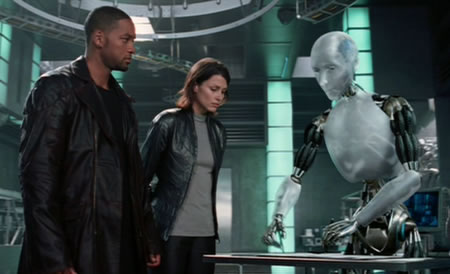
In 2004 came the (loose) movie adaptation of Asimov's vision: I, Robot


Fast-forward to 2014. Where are the robots today?

I feel a bit let-down, even though I hear of advances such as medical assistant robots and future robotic assistants, such as Jibo, which are slowly advancing towards a robotic future.

I found the following article illuminating, especially since the title agrees with my question above: iRobot CEO decries the slow advance of robotics.

Here's an interesting insight from the article:
Pam Henderson, a former assistant professor at Carnegie Mellon University and co-founder and CEO of consulting firm NewEdge, Inc., agreed, adding that too many roboticists are in love with their own ideas.
"Some of you have one idea you are in love with and you are going to ride that thing until it goes to market or it kills you," Henderson said during a keynote talk at RoboBusiness. "Robotics is not the industry. Appliances are the industry. Home health care is the industry. The need isn't for a robot.... What's the opportunity? No opportunity? Don't build. Be pretty crisp on the applications before you do the development."

In the end, it comes down to money:
"It takes $20 million or more to build a legitimate robot. It's a much bigger check to write to get to play," said Colin Angle, CEO and co-founder of iRobot (the maker of the Roomba vacuum cleaners).

Allow me to add my personal appeal to all the Angel Investors out there:
Please don't overlook the robots!

Sunday, December 4, 2011

The Blame Game

I read an article in the Nov. 26 issue of The Economist, titled "A downgrade for Congress". 
It begins: "It was not a very ambitious target.  All that the congressional "supercommittee" was required to do was to figure out a list of measures that would reduce America's budget deficits by $1.2 trillion over the next ten years.  That sounds like a lot, until you realise it is only 0.6% of GDP, not even a quarter of the $5 trillion or so that is really needed to right the books in Washington, and less than 3% of the $44 trillion that the federal goverment is expected to spend over that period.  To reach a goal that a business cost-cutter would regard as desultory, the bipartisan committee of 12 senators and congressmen was accorded exceptional powers.  Its work was to be subject to a simple up-or-down vote, with no possibility of amendment; and the Senate would not be able to use its power to filibuster.  Yet on November 21st, after three months of deliberation, the team was forced to admit that it had failed."

And the Blame Game kicked into high gear, the Democrats blamed the Republicans, the Republicans blamed the Democrats and the public was left shaking our collective heads at the degree of dysfunction we witness daily amongst our elected officials and the partisanship which has been elevated to a new level.

The article concludes with one suggestion why the supercommittee might have failed to meet its goal = no real sense of urgency.  "America is not Italy: this week, its ten-year government bonds were trading at well below 2%, the lowest levels for over half a century ..."

Which brings me to the last point I wanted to make regarding the "Blame Game."
I was thoroughly disgusted with all the blame being heaped upon little ole Greece during the summer and early Autumn.  Yes, the Greek politicians had managed (mismanaged sounds better) to completely over-leverage their country and had dug a massive hole for themselves -- and the various bankers were all-too-happy to saddle them with bailouts, which, it should be pointed-out, are not "gifts", but rather additional loans with crushing terms.  Massive austerity measures were depressing everything and everybody in Greece and the rest of the world was using it as a scapegoat for the mess the Europeans were finding themselves in ... blame it all on the Greeks!

That's where the other shoe dropped.  Wait a minute ... perhaps Italy has an economic problem, oh and Spain too.  Italy isn't a small economy, like Greece, they are the #3 economy in the Euro zone.
Now all of a sudden the European economic powerhouses are calling an emergency meeting early next week to figure a way out of the looming economic meltdown ...

I wonder who will be blamed next.
More importantly, I hope the Blame Game stops and we start seeing the politicians and the bankers working cooperatively to bring the world economy back to health.

Tuesday, November 1, 2011

Food, Water, Energy and Population Growth

I had the opportunity to eat a Primanti"s sandwich last week, which got me thinking ... more on this in a moment.

For those of you who may have not heard of this before, Primanti Brothers is a chain of restaurants in Pittsburgh, who serve a rather unique sandwich that has attained iconic status in this city.
The history behind this sandwich is fun to read, though I have a hard envisioning somebody eating this sandwich with one hand, while driving a truck with the other ... it is simply (huge http://en.wikipedia.org/wiki/Primanti_Brothers).

We heard on the news a month ago, that Primanti's has been named one of the "manliest" sandwich restaurants in the nation - a rather dubious honor, but one which caused more than a few smiles. 
In case you want proof, here is a link to a picture of me eating my Primanti's sandwich - snapped by my sister (https://www.facebook.com/#!/photo.php?fbid=10150373631472512&set=at.66614997511.70714.820847511.820847511&type=1&theater).

Enough with the frivolity however.  What triggered this blog post was a story I heard over the weekend, that global population would reach an estimated 7 billion people on Monday, Oct. 31, 2011 and related news stories yesterday and this morning.
You may enjoy watching the video at the top of this story, which helps visualize the growth of the Earth's population over the last few thousand years (http://www.npr.org/2011/10/31/141816460/visualizing-how-a-population-grows-to-7-billion).

The question of how many more people can live on Earth, what some scientists call Earth's carrying capacity, is a very complex one, with many variables potentially coming into play (http://en.wikipedia.org/wiki/Carrying_capacity). One way to simplify the equation, is to talk about food, water and energy.

The food part of the equation is how I started this blog post -- meat and animal-derived products require more land and resources than grain-based foods -- the thinking is that as more people around the world enter the middle class, they will want more meat and animal-derived products, which will strain global food production.  Improvements in agriculture may be able to offset this increased demand (to a point).

The water part of the equation is one which seems to be more dramatic in some parts of the world than in others.  It is fair to say however, that access to clean water for an increasing global population will be a huge problem to overcome in the years to come.  Water supply and purification mechanisms, as well as improvements in infrastructure to deliver the clean water to the population with minimal losses (and to remove the dirty water), will be definite areas of attention.

Then there is energy.  One news story mentioned that parts of the world which are more developed are currently enjoying "cheap energy" and that the developing world will also want access to the same amount of energy being consumed in the more developed countries. A finite oil and fossil fuel supply is only part of the problem here -- it is also worth considering the energy efficiency of whatever we use which consumes energy and also energy wasted due to carelessness.

One of the areas of my job I truly enjoy, is related to AEVs (Alternative Energy Vehicles) and all the lightweight and energy-efficient materials my company supplies which can decrease the weight of any vehicle while simultaneously increasing their energy-efficiency.  If you are interested in finding out more about this, feel free to check-out our Facebook page -- and if you like what you see, kindly click on the "Like" button too (https://www.facebook.com/BayerMaterialScienceAEV).  Thanks!

Tuesday, September 6, 2011

The 118

I was reminded today of a phrase I heard from Jeffrey Hayzlett (ex-CMO at Kodak).   
He was talking about "The Elevator Pitch" - 2.0 
He calls it "The 118" -- as in: "you have 118 seconds to get your point across". 

His position is that the average adult's attention span is 8 seconds -- that's all the time someone has to make an initial impact.  The other 110 seconds, what Jeffrey claims is the average time an elevator ride lasts in NYC, is how long you have to "sell" him/her. 

Phrased differently, if you are preparing a long-winded presentation, hoping to impress me, you are approaching this the wrong way.
Obviously, you will not be able to come up with the correct words and to structure your position/proposition in that short a time period without some serious preparation and practice. 
... so heads-up, make sure you practice!

I got a cold call today, from someone talking 100-miles-an-hour, hoping to impress me by throwing out names of well known, major companies, who he claimed were clients -- *yawn*!
After 30 seconds he had not even begun to get close to his point, after 120 seconds I still had not heard his value proposition ... so I cut him off. 
I explained he had failed to "hook" me, that I was not trying to be rude, however I was very busy and I just did not have the time to sit and listen to the stuff he was rattling off. 
It became apparent he was annoying me. 

My parting words were that he needed to practice his 118 and I gave Mr. Hayzlett and his book "The Mirror Test" a "plug". 
You are welcome Jeffrey.
Now I need to go practice my own 118 ... 
Summer vacation is over people, let's get with the program! 

Monday, August 8, 2011

The Brink

A divided government that seems stuck in perpetual gridlock, took the US economy to the brink of default, only to be saved by a last-minute agreement last week. 
Apparently this was not enough for Standard & Poors (S&P), the debt rating agency which was not capable of warning about impending problems with Lehman Brothers, or with the mortgage debt crisis a couple of years ago.  
S&P downgraded US debt from AAA to AA+ and the stock market which had been having one bad day after another for the past two weeks, had an absolutely horrendous day today.  Over the last couple of weeks, the stock market has declined by a figure that is closing-in on 20%. 

Meanwhile, the President has a mere 42% approval rating and Congress has a dismal 14% approval rating! 
The polls notwithstanding, it should be immediately obvious to even the most casual observer that the citizens of the US do not think any of the politicians are doing anywhere near an acceptable job.

I think it is clear we are not simply approaching the brink of disaster; we are teetering on the very edge.  The question before us now is: can any one of the political geniuses figure-out how to keep us from tumbling over that edge? 

Friday, July 8, 2011

Adventures in Space

I experienced a bittersweet moment today, as news arrived that the shuttle Atlantis did manage to lift off from Cape Canaveral for the last time a few hours ago, despite the inclement weather in Florida -- here in Pittsburgh as well, it is overcast and rainy.
I liked this coverage in the Washington Post (http://www.washingtonpost.com/national/atlantis-astronauts-ready-for-final-launch-as-nasa-keeps-watchful-eye-on-cloudy-weather/2011/07/08/gIQA8FcR3H_story.html?wpisrc=al_national).
I also recommend clicking on the second video link for a brief (less than 6 min) history of the Space Shuttle program from the 1st to this the 135th and final flight (http://www.washingtonpost.com/national/health-science/remembering-the-shuttle-era/2011/07/01/AG35yStH_video.html).

I have previously blogged about the "Coolest Job Ever", so my personal angle/excitement about the subject should be obvious. 
The truth of the matter however, is that the International Space Station is now manned and operational and the only existing means of moving people to/from it are the Russian Soyuz spacecraft.  Unfortunately, the Soyuz spacecraft can carry far less in both personnel and payloads/cargo than the Space Shuttles.
Since it will be years before NASA's successor to the Space Shuttle will be operational, I believe the adventures in space (OK, near-Earth orbit if you want to be nit-picky) are just beginning. 

From an economic/financial standpoint meanwhile, there will be thousands, if not tens of thousands of people currently employed by NASA, who will be added to the ranks of those seeking employment during these tough economic times.  I would like to wish each of them a speedy resolution to their personal adventure as well.